

- The Numbers, Side by Side
- So What Does the Premium Buy?
- Who Actually Belongs in Each Village
- Frequently Asked Questions
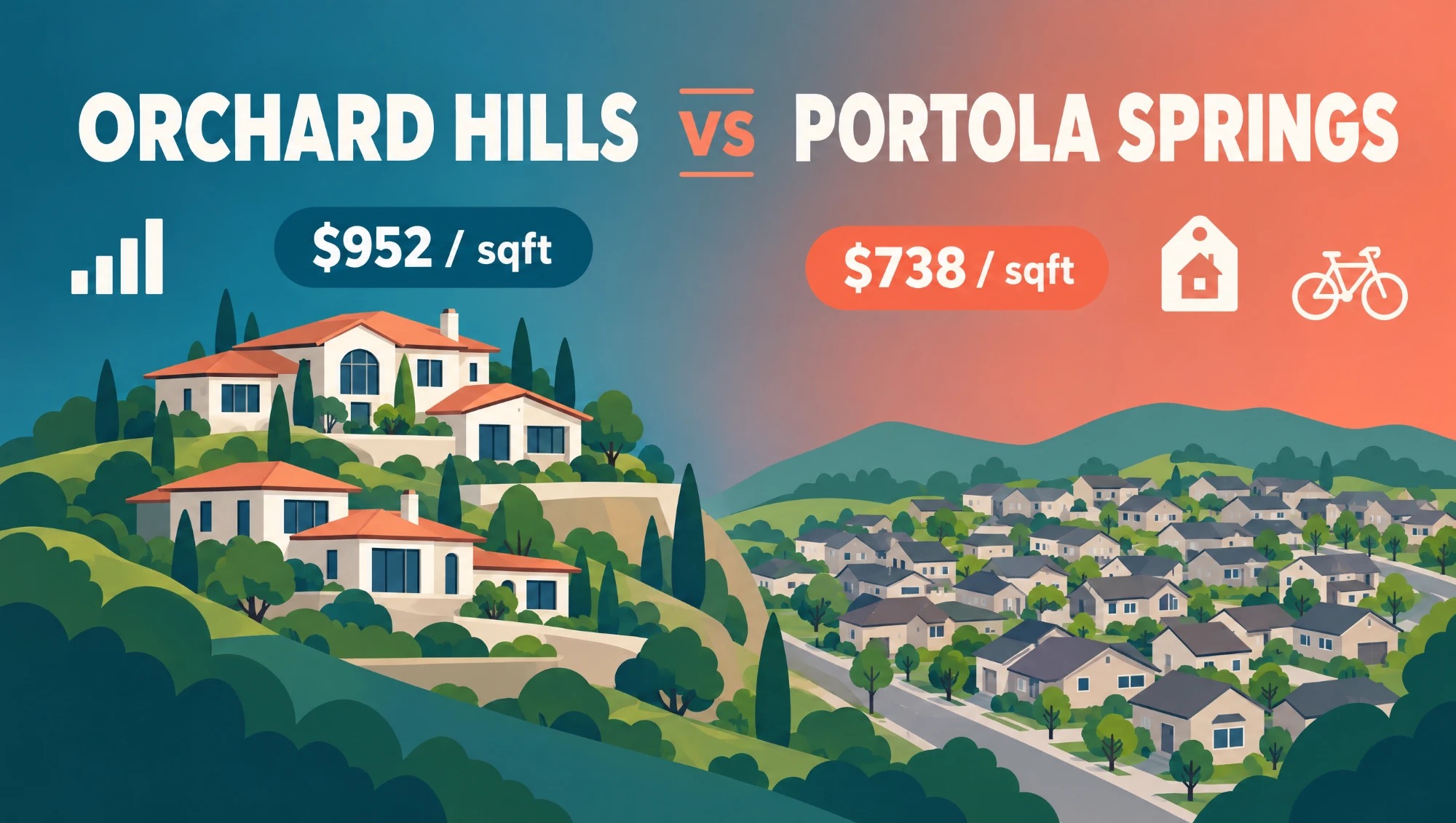
The short version: Orchard Hills homes are selling for a median $2,928,586 right now against Portola Springs' $1,799,132 — a roughly 63% premium. On a price-per-square-foot basis it's $952 versus $738, about 29% more. Both villages are newer, both sit against the hills, and both post nearly identical sale-to-list ratios (97.1% vs 97.0%). So the premium isn't about which village is "hotter" — it's about what you're actually buying with the extra money.
Buyers cross-shopping these two villages usually start with the wrong question. It's not "which is better" — it's "what does the premium actually get you," because on paper the two markets behave almost identically.
The Numbers, Side by Side
| Orchard Hills | Portola Springs | |
|---|---|---|
| Median sale price (Aug 2026) | $2,928,586 | $1,799,132 |
| YoY price change | +3.5% | −0.048% |
| Price per square foot | $952 | $738 |
| YoY price/sqft change | −1.9% | −13.9% |
| Median days on market | 54 | 71 |
| Sale-to-list ratio | 97.1% | 97.0% |
| Homes sold above list | 15.7% | — |
| Redfin Compete Score | 45 (somewhat competitive) | 41 (somewhat competitive) |
| Walk Score | 3 | 6 |
| Bike Score | 9 | 50 |
Source: Redfin neighborhood market data, three months ending August 2026.
A few things jump out. Orchard Hills is moving faster (54 days versus 71) and pulling more above-list offers (15.7%), even though its price is up year-over-year while Portola Springs' is essentially flat. And despite Orchard Hills being the pricier, hillier, more prestige-coded village, Portola Springs is dramatically more bikeable — a 50 Bike Score against Orchard Hills' 9. If you actually want to ride a bike to anything, that's a real trade-off the price tag doesn't tell you.
So What Does the Premium Buy?
Elevation and privacy. Orchard Hills sits higher against the Santa Ana foothills, with more lots backing to open space and canyon views. That's baked into land cost in a way square footage alone doesn't capture.
A different builder mix and finish tier. Orchard Hills skews toward larger, more custom-feeling homes from builders like Toll Brothers and Brookfield, including the newer Summit at Orchard Hills phase. Portola Springs' product runs newer overall but denser, with a heavier mix of attached and small-lot detached homes.
Schools, on paper, are a wash. Both villages post 10/10 GreatSchools ratings across their core elementary options — Santiago Hills Elementary and the Orchard Hills K-8 campus on one side, Stonegate Elementary, Portola Springs Elementary, Beacon Park K-8 and Loma Ridge Elementary on the other. Nobody is paying the Orchard Hills premium for better test scores; the ratings don't support that.
Inventory behavior tells a quieter story. 35.5% of homes in Orchard Hills have taken a price drop this year — a meaningfully higher share than what we typically see in Portola Springs' faster-turning, lower-price-point listings. That suggests sellers at the top of Orchard Hills' range are testing higher and getting corrected more often, even as the median keeps climbing.
Who Actually Belongs in Each Village
If elevation, privacy, and a more custom-home feel matter more to you than commute time or bikeability, Orchard Hills' premium is buying something real. If you'd rather ride to your kid's practice or the village center without getting in a car, Portola Springs is doing more for the money — and doing it at a price point that's held essentially flat year-over-year, which is its own kind of opportunity if you think that won't last.
Trying to figure out which village actually fits your budget and your life, not just your Pinterest board? Let's talk — or see what a move in either direction would do to your numbers with a free home valuation.
Frequently Asked Questions
How much more expensive is Orchard Hills than Portola Springs?
As of August 2026, Orchard Hills' median sale price is $2,928,586 versus $1,799,132 in Portola Springs — a premium of roughly 63%. On a price-per-square-foot basis, it's $952 versus $738, about 29% more.
Which village sells faster?
Orchard Hills, currently averaging 54 days on market versus 71 in Portola Springs.
Are the schools actually better in Orchard Hills?
Not by the numbers. Both villages' core elementary and K-8 schools carry 10/10 (or 9-10/10) GreatSchools ratings.
Which village is more walkable or bikeable?
Portola Springs, by a wide margin on biking — a Bike Score of 50 versus Orchard Hills' 9. Walk Score is close (6 vs. 3); both are effectively car-dependent for daily errands.
Is Orchard Hills' price growth outpacing Portola Springs'?
Yes — Orchard Hills is up 3.5% year-over-year on median price, while Portola Springs is roughly flat (−0.048%). Portola Springs' price-per-square-foot is down more sharply (−13.9%) than Orchard Hills' (−1.9%).